
Stock-Keeping Unit (SKU)
A stock-keeping unit (SKU) identifies goods a business treats as interchangeable when counting stock. Twenty-four cases of plain yogurt at a depot can make up one SKU even if they came from two production lots. The dairy packs each case to the same specification, so the grocer can order by code. The picker still has to read the date. Introduction to Supply Chain, §4.3.1, “Standardization”
One catalog item, three stock records
Two stores, Park and Station, draw their yogurt from the same depot. Ask the grocer’s catalog manager how many SKUs that flavor and pack size represent, and the answer is one. The replenishment planner counts three, one item–location pair for each store and one for the depot. The warehouse crew might split the depot’s stock across two bins. The buyer can still replenish both bins with one order.
A zero balance at Park might mean the last cup sold this morning. Across town, a store that has never carried the yogurt may have no row for it in the stock file. Fill every missing row with a zero and the next delivery run can send yogurt to both shops. The assortment in effect that morning tells the planner which store had a shelf to refill.
At the checkout, one scan sells one cup. On the dairy’s invoice, one unit buys a case. Last month the depot received twelve cases of six, or 72 cups. If the dairy now packs eight to a case under the same code, looking up today’s pack size will turn last month’s receipt into 96 cups. A buyer can recover the original quantity if the receipt says “six per case” or the dairy’s pack sizes are dated.
Which lot can go on the truck?
On Monday morning each store orders twelve cases for delivery that day. Station accepts yogurt with one day of shelf life left on arrival. Park requires three. The depot has twelve cases from lot A, expiring Tuesday, and twelve from B, expiring the following Monday.
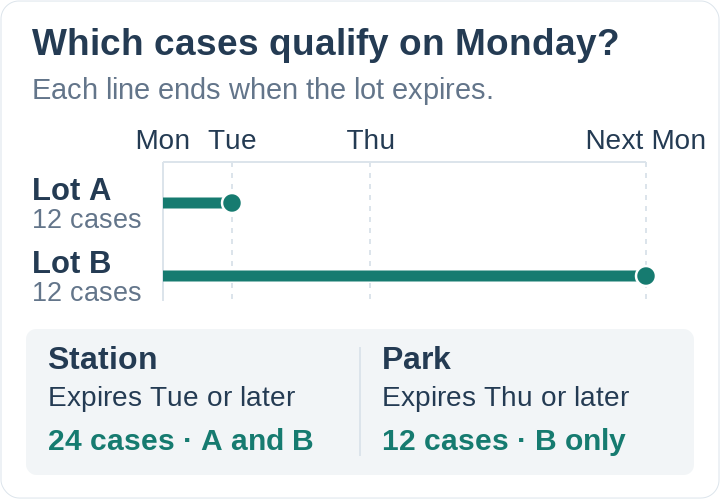
The dispatcher can offer Station 24 cases and Park twelve. Those offers overlap. Promise B to Station and Park gets nothing. Send A to Station and B to Park and both orders go out in full. If the truck slips to Tuesday, even Station will refuse A, although the depot still has the same 24 cases in the cold room.
A single expiration date on the yogurt’s item record gives the picker the wrong date for one lot. Each lot needs its own date. Park’s three-day requirement goes in its delivery terms for yogurt, where it also applies to next week’s lots.
An aircraft maintenance shop can own two pumps with the same part number and have only one ready to install. The other is away for repair. When it comes back, its serial number ties the repair to the pump’s service history. Book the return as a new pump and the ledger shows three pumps where the shop owns two. Miami, a supply chain persona
How a join can double an order
Take another customer order for eight cases of yogurt. In the order file, eight appears on a single line. In the stock file, the yogurt has two rows at the depot, one per lot. Join the files on item and depot and the eight appears beside A and again beside B. Total the order column and the report shows sixteen cases ordered.
For a Monday morning buying report, add the lots of each item at each site once, using that morning’s stock snapshot. Compare that balance with the quantity still due to customers at the same cutoff. Adding yesterday’s closing stock to today’s would count every case that spent the night in the depot twice.
Say the depot ships five cases from A and three from B against the order for eight. If the dairy recalls B, the original order tells the depot little. Recording the lot and quantity shipped against that order line lets the depot trace the three cases from B to the customer who received them.
Even two stock balances bearing the same timestamp can overlap. The online shop shows six cases reserved for pickup. If the warehouse transfers them to a virtual pickup location, eighteen remain in the main location and the two rows add up to 24. If the reservation flags six cases already included in the depot’s 24, adding the rows produces thirty. Either system can use exactly the same SKU codes. Perpetual Inventory
When several SKUs can fill one request
At a parts counter, a mechanic asks for a filter for a van. The clerk has one F and one G, and either will fit. Next in line is the owner of a sedan that takes only F.
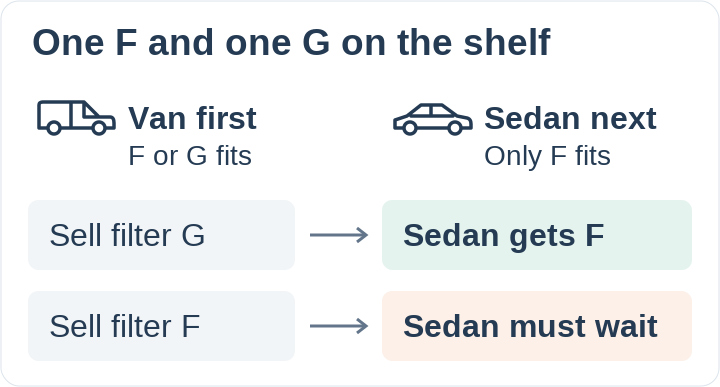
The catalog needs an entry for each vehicle model a part fits. Mark F and G as equivalent parts and a search for the sedan can turn up G. At the till, selling F to the van leaves a receipt for one filter. The sedan owner who walks out empty-handed may leave no record at all. Even the receipt for F, without the vehicle model, gives the buyer no way to tell whether G would have served that customer. Why SKUs Aren’t That Simple
Where the sales history belongs
Twelve cups sold across the chain could mean twelve at Park and none at Station. The buyer needs sales by store to plan the next delivery. Yet Park may sell too few cups of this particular yogurt to tell whether it sells better on Saturdays. In Lokad’s entry to the M5 forecasting competition, sales across a store’s department helped estimate the day-of-week effect. Each item in that store shared the pattern and kept its own forecast. The M5 forecasting lecture
The lot number is often the finest detail in the shipment file. Plot shipments of A and B separately and demand for B appears to take off the day A sells out. The customers still order plain yogurt. All that changed that morning was which lot the picker opened.