



Whether in retail or e-commerce, every price change is a strategic decision that influences both short-term sales and long-term profitability.
Traditional pricing methods focus on simple elasticity models, assuming that lower prices always boost sales in a predictable way. But in reality, pricing is far more complex:
- Discounts can cannibalize sales of similar products instead of generating new demand.
- Price-sensitive customers may shift between categories, altering demand patterns.
- Customers remember past discounts. Bad discount strategies can create unhealthy expectations and behaviors and damage the brand over time.
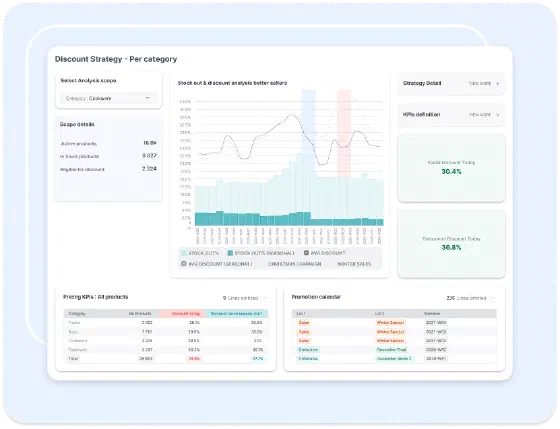
- A poorly planned promotion can drain inventory too soon, leading to stockouts and lost revenue.
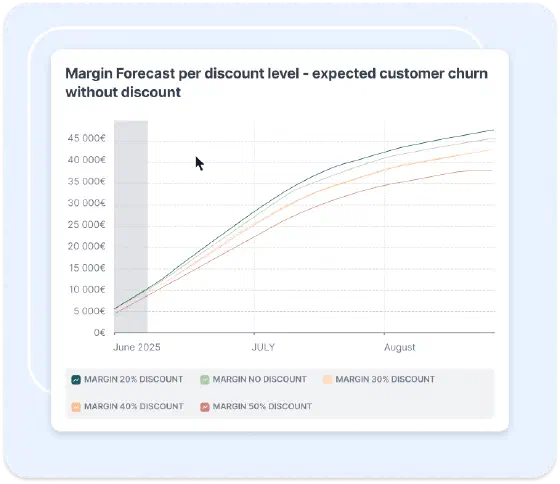
Lokad’s Pricing & Promotion Optimization goes beyond elasticity calculations. Using probabilistic forecasting and multi-product demand response modeling, our AI-driven approach ensures that every price adjustment is optimized for long-term financial impact.
Key concepts to success
Why traditional pricing strategies fall short
Most pricing approaches rely on:
- Elasticity models → Assume each product behaves in isolation between products or over time (it doesn’t).
- Fixed discount levels → Apply generic promotions without considering lasting impact on brand value.
- Excessive promotions → Products are discounted unnecessarily, eroding margins on items that could have sold at higher prices.
- Rule-based pricing → Lack adaptability to fast-changing demand and inventory conditions. Make pricing mistakes invisible.
Pricing is a High-Stakes Trade-Off
Every price adjustment must balance three key factors:
- Matching perceived value by customers → Does the pricing reflect the customer’s expectation for the brand?
- Inventory opportunities → Will the discount help boost sales, clear inventory efficiently or cause stockouts?
- Building brand value over time → How to send a proper signal to the market on product value?
The Lokad approach: Probabilistic Demand Response Pricing Model
Rather than relying on simplistic formulas, Lokad uses AI-powered statistical modeling to capture the true impact of pricing decisions.
- Demand Response Modeling → Forecasts the full range of possible demand responses over the whole assortment, rather than assuming a single fixed effect.
- Multi-Product Approach → Analyzes cross-product relationships to prevent cannibalization and optimize category-wide profitability.
- Financial Optimization → Ensures every promotion is justified by its long-term impact on total revenue, margin, and stock flow, while preserving brand value.
Tailored to your industry
- Retail & Supermarkets: Promotions on high-visibility items should increase total basket size, not just erode margins. Lokad optimizes category-wide pricing to increase total revenue, not just unit sales.
- E-commerce & Flash Sales: Dynamic pricing should react in real time to demand surges while preventing premature stock depletion. Lokad prevents over-discounting and optimizes inventory clearance.
- Fashion & Seasonal Products: End-of-season discounts must clear stock while maximizing profit. Lokad produces smart markdown strategies to reduce waste and boost total category performance.
What Lokad Delivers
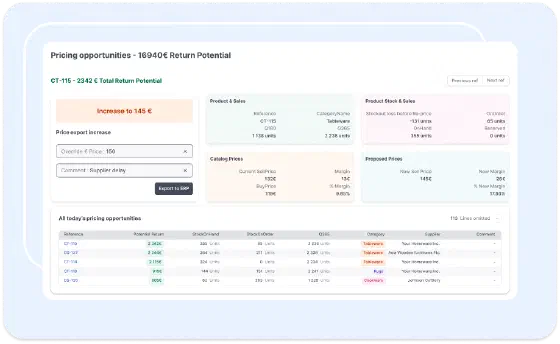
- Dynamic price recommendations at SKU level, based on real-time demand forecasts.
- Promotion optimization models that maximize revenue while controlling cannibalization effects.
- Financially justified pricing strategies, balancing margin, demand, and inventory levels.
- AI-powered dashboards for price tracking, demand insights, and revenue impact analysis.
From Gut Feeling to AI-Driven Pricing
With Lokad, pricing is no longer about blindly following elasticity curves or applying generic promotions—it’s about statistically optimizing each price move for maximum financial impact. Ready to transform pricing into a competitive advantage? Let’s talk.


