
Log In Contact Us

AI Solutions for Oil & Gas Operations
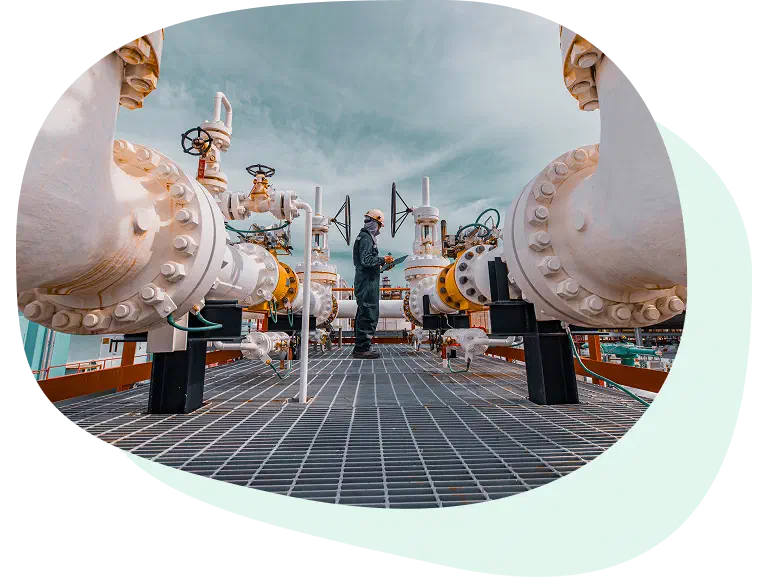
Raise uptime while shrinking expediting and idle stock. Turn your data into daily, financially smart decisions: what to buy, where to stage, when to repair, and how to move.
Request a discovery call
AI Solutions for Oil & Gas Operations

Operational problems we fix

  • Costly downtime: One missing fastener, seal, or sensor halts a platform or FPSO
  • Yard bloat: Offshore and onshore locations accumulate obsolete/duplicated stock
  • Hot-shots: ASAP ground shipments with high call-out and per-mile costs
  • Helicopter burn: Emergency delivery of critical parts to offshores sites
  • Lead-time chaos: OEMs, repair shops, customs, and weather produce delays
  • Siloed tools: ERP/EAM and spreadsheets record the past but don’’t optimize decisions
Supply chain in oil and gas
Check our modules

How we do it

  • Supply Chain Scientists (SCS)

    Your dedicated SCS (or team of SCSs) codes your economics (downtime cost, logistics modes, compliance constraints) and partners you from kickoff to golive and continuous improvement. This lets the SCS supervise (and improve) your decision-making algorithm as your assets, vendors, and sites evolve.

  • Better financial decisions

    Every decision (replenishment, transfer, or repair) is evaluated in financial terms, such as uptime risk vs holding, estimated freight cost, and obsolescence risk). This means you maximize ROI for every single decision.

  • Artificial intelligence

    Your SCS team uses a unique coding language (Envision) and artificial intelligence to solve networkwide decisions every night. These decisions respect your MOQs, lot multiples, container fill, and supplier price breaks.

  • Generate buy-in

    We run "current process" vs "Lokad's process" sidebyside so you see the financial impact on uptime risk and operations costs before you switch.

  • Forecast for uncertainty

    We compute full demand and leadtime distributions instead of simple time-series forecasts. This probabilistic forecasting technology is essential for longtail, intermittent part consumption and unpredictable transit; the things you find in oil & gas all the time.

  • Automation

    Lokad is a single layer on top of your ERP/EAM (SAP, Maximo, IFS, etc.). We extract data through daily flat files/APIs. Our engine automatically produces purchase orders, intersite transfers, and repair priorities that you can choose to apply or query.

  • No new hardware or software

    Working with us does not require new hardware or ERP change. Our supply chain decisions are piped directly to your pre-existing software on a daily basis.

  • Rapid deployment

    Full go-live in under 6 months (on average). Learn more [here]

Project implementation

Common questions answered

How fast will we see results?

We start with a dualrun (current process vs Lokad’s process) that quantifies the delta on uptime risk and total cost. Once validated, automation frees up planners to focus on strategy. Typical results visible in 6-8 weeks (general estimate).

Can Lokad handle offshore networks and remote bases?

Yes. Our algorithm can handle multiechelon networks. It can weigh staging across platforms, shore bases, and yards. This algorithm factors your MOQs, lot sizes, and transport choices.

Do you model repairables and rotables?

Yes. We factor repair TAT distributions and pool levels to balance exchanges, holds, and buys. This is a very similar approach that we commonly use in aerospace (particularly MRO operations) and is directly applicable to O&G tooling.

Will planners still have control?

Absolutely. They can review, lock or override any recommendation while shedding routine spreadsheet work.

Do we need a new ERP/EAM?

No. Lokad’s decisions can be integrated into your ERP/existing enterprise software. Integration is done through simple flat file transfers or APIs, and follows our standard dataextraction pattern.

How is the solution priced?

A simple monthly subscription aligned to network size. No peruser fees or surprise costs. No long-term commitment.

Analyzing Oil & Gas Supply Chain

Joannes Vermorel (Lokad Founder and CEO) explains why better financial decisions and automation beat manual spreadsheets for onshore and offshore logistics.
Request a discovery call

The technical details

Forecasting all sources of uncertainty

We estimate full distributions for demand, lead time, and all other sources of uncertainty. We do this using probabilistic forecasting. Our decision-engine integrates these uncertainties rather than ignoring them (as per time-series forecasting and spreadsheet planning). We capture erratic, lumpy demand plus variable supplier lead-times, so the optimizer weighs the full risk distribution (measured in dollars/euros) when deciding what to buy, where to send it, etc.

Network-wide optimization

Each overnight run solves for where to hold how much (per site and SKU) under capacity, hazard handling, and budget constraints. Our differentiable programming and domain-specific language (Envision) accelerates convergence on large relational datasets. This allows us to optimize multi-echelon networks each night.

Decisions ranked in money

Every feasible action (buy, transfer, repair, expedite) gets an expected financial score that blends downtime risk, working capital, logistics, price breaks, MOQs/lot-multiples, shelf-life, etc. These economic drivers are explicit and auditable, not hidden inside a solver. We then pick the decisions that maximize financial return (or whatever criteria you wish to optimize).

Repairables & rotables done right

We model pools, repair queues, TAT distributions and yields. We can prioritize “repair vs. buy vs. cannibalize” to keep rigs and plants online with minimal capital tied in spares. This approach is proven at scale in aerospace (MRO) and transfers cleanly to O&G tool strings and critical subsystems.

Validation before automation

During onboarding we run Lokad’s algorithm alongside your current process, instrument gaps, and quantify deltas in €/$ (uptime risk ↓, inventory/expedites ↓). Once the financials and decisions are “sane”, we “robotize” the routine decisions and keep humans involved for oversight and to assist in continuous improvement.

Differentiable programming over relational data

We use automatic differentiation end-to-end (including through joins/aggregations) to tune our decision algorithms to satisfy your objective(s). This makes large, intertwined decisions (e.g., multi-echelon staging under stochastic lead times) tractable and fast to iterate.

Secure, enterprise-grade delivery.

Calculations burst onto hundreds of Azure cores, then spin down to keep costs low. Data stay encrypted end-to-end and the platform inherits ISO 27001 controls, SSO, and role-based access. Because Lokad layers on top of your existing ERP/MRP, no new hardware or rip-and-replace project is required.
Ask Lokad