
Backorders
A backorder is the quantity a seller still owes a customer because it could not fill the order from stock. A mechanic orders six bearings and takes home the only two on the shelf. The dealer agrees to send the remaining four. All four are now on backorder, even if the dealer already has a box of bearings on tomorrow’s truck.
When two customers are waiting for the same part, a late truck can change who should get it. A paper mill can use a drive on Friday morning to keep an installation appointment. By Monday the crew has gone, and the same drive can save a repair depot another day’s rental.
What the seller owes
A shopper can find the bin empty and walk out. The till records nothing about that stockout or the quantity the shopper wanted. The mechanic’s backorder records who is waiting and for how many bearings. If the mechanic cancels one, three remain due. Reserving three from the next truck covers the order. The mechanic is still waiting for the bearings.
Link shipments and cancellations to the original order line. The mechanic asked for six, canceled one, and ultimately received five. Counting the final shipment as fresh demand would turn a request for six bearings into an apparent request for nine. Keep the customer’s requested date, the dealer’s original promise, and the latest delivery estimate. If the dealer overwrites a Friday promise with a Monday estimate, a delivery three days late can show up as on time.
Two customers waiting for the first drive
On Monday, November 2, a distributor has sold two interchangeable drive units, one to a repair depot and one to a paper mill. Neither is on the shelf. The depot ordered first. It can return its rental on Thursday morning at no extra charge. Each day it keeps the rental beyond Thursday costs the distributor $40, weekends included. The mill has an installation crew booked for Friday morning. If its drive misses that appointment, the distributor owes $240 to bring the crew back on Tuesday.
One drive is on a truck with a 75% chance of reaching the pickup counter on Friday the 6th in time for the crew. Otherwise it will arrive on Monday the 9th. The other drive is still at the supplier and will be ready for pickup on Tuesday the 10th with regular freight. Both customers will wait and pay the agreed price. Either can collect early, and neither has contractual priority.
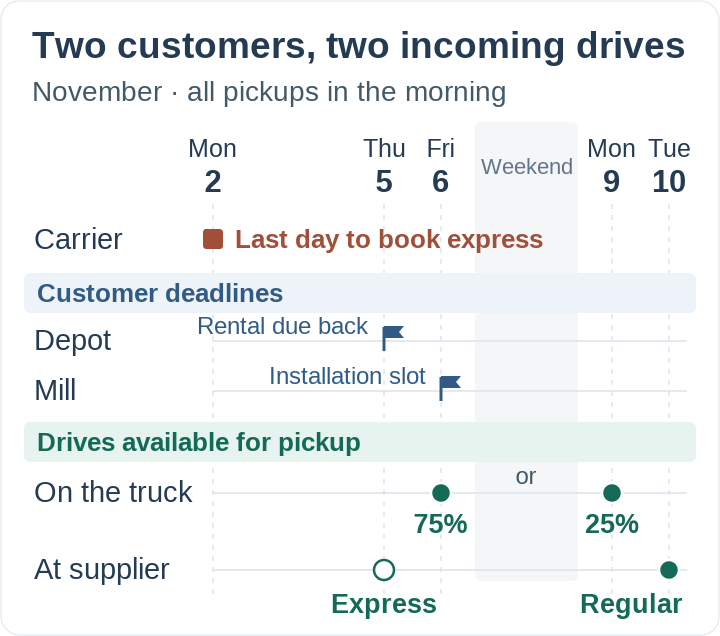
With regular freight, the customer who misses out on the truck waits until Tuesday. If it arrives Friday, give the drive to the mill. The distributor avoids the $240 crew charge. Giving it to the depot would save four rental days, worth $160. With the mill served first, the only bill is for the depot’s five rental days, $200.
If the truck arrives Monday, give the drive to the depot. The mill has missed its appointment and the $240 crew charge is due either way. The depot can still return its rental a day early. The distributor pays $160 for four rental days and $240 for one missed appointment.
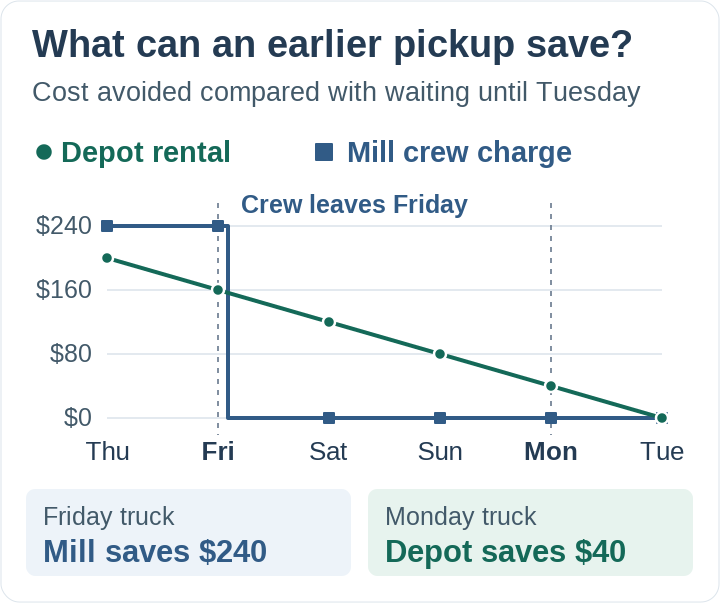
Saturday and Sunday both count toward the depot’s rental bill. Missing Friday costs the distributor one crew charge at the mill, however many days the part sits on the truck before Tuesday.
Serving the oldest order first would send the Friday drive to the depot. That costs $80 more on Friday and makes no difference on Monday. At a 75% chance of a Friday truck, the rule adds $60 on average. Both rules clear the backlog by Tuesday. A buyer scanning the list of open orders that afternoon would see no trace of the difference. For the economics of pricing a shortage across customer accounts, see chapter 8 of Introduction to Supply Chain.
What is express freight worth?
The carrier offers to collect the drive still at the supplier and have it at the counter on Thursday for $150 extra. The distributor must book on Monday. Even on Thursday, when it can hand that drive to a customer, it still won’t know whether the other drive will arrive on Friday. The costs below include any added freight, rental, and crew charges.
| Truck arrives | Regular freight | Express to depot |
|---|---|---|
| Friday (75%) | $200 | $150 |
| Monday (25%) | $400 | $390 |
| Expected bill | $250 | $210 |
Sending Thursday’s drive to the depot ends the rental on time. There is still a one-in-four chance of paying the mill’s $240 crew bill. That leaves $60 in expected delay charges, down from $250 with regular freight. The difference, $190, is the most the distributor should pay for express. At the carrier’s $150 quote, it saves $40 on average.
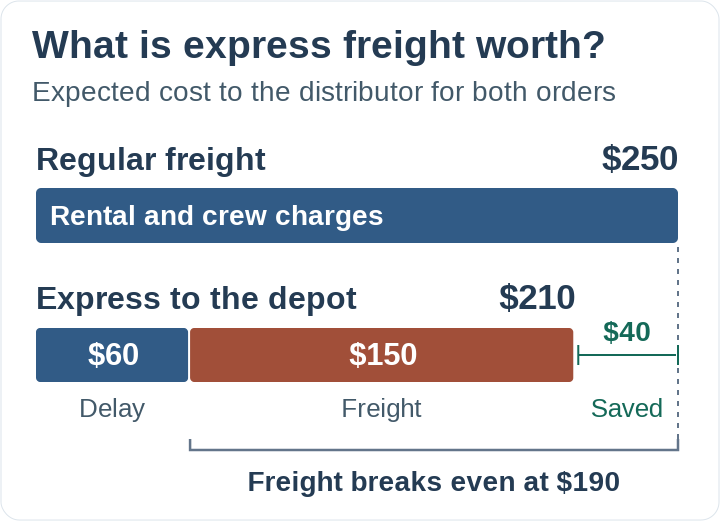
Suppose the mill wants a guaranteed Friday pickup. Reserve Thursday’s drive for the mill and the crew charge disappears. The depot then waits for the truck, at a rental cost of $40 if it arrives Friday or $160 if it arrives Monday. That averages $70. With freight, the expected bill comes to $220. The guarantee costs the distributor $10 over the $210 plan. It could be worth considerably more to the mill if missing the crew would leave a production line idle. Once the distributor gives its word, the mill’s name belongs on Thursday’s drive.
A revised arrival estimate can change the reservation before anyone makes a firm promise. If the chance of a Friday truck falls to 50%, sending the express drive to the depot leaves a $120 expected crew bill. Send it to the mill and the depot incurs either $40 or $160 in rental, averaging $100. At the same freight price, the mill now has the better claim.
Quoting a date to the next customer
Stock in transit. A third customer calls on Monday. Two drives are on order and both have buyers. To quote a pickup date, find the next unreserved drive. If it is in a container due at the port on Friday, allow for unloading, customs clearance, inspection, and the truck journey inland. All four belong in the remaining lead time to the pickup counter.
Returns and repairs. A used drive can fill a backorder once it passes inspection. Suppose eight out of ten returns reach the workshop by Thursday, and six of those eight pass inspection that day. Promise all ten customers a Thursday pickup and four will still be waiting. Two drives have yet to arrive and two are in the workshop. This matters particularly in aerospace purchasing and repair, where a company can own a part for weeks before it is fit to install.
A supplier minimum. A customer needs one bearing and the supplier sells boxes of twelve. The buyer who orders a box to fill the backorder also commits cash to eleven bearings with no buyer yet. If those eleven might sit for years, paying more per bearing elsewhere can be a good deal. Check the minimum order quantity before quoting a date. If a promise already made is going to slip, call while a substitute or a partial shipment might still help. If the customer cancels, release the reservation before the next replenishment decision.