
Stock Replenishment
Stock replenishment is a supply chain decision about how much of an item to put in a store, warehouse, or production bin, from which source, and by when. Buying a case spends money that could buy another item. Moving the last case out of a warehouse gives one store the chance to sell it and takes that chance away from the others. Releasing a production order reserves time on a line that could make something else.
Consider two stores, East and West. The retailer knows exactly how many units shoppers at East will want this week. It could serve every one of them and earn less than if it let some walk away. The last few units on West’s shelf have customers of their own.
Which sales can still be served?
On Monday morning, East store has two units left. Customers want two a day through Friday, and anyone who finds the shelf empty leaves without buying. An open order for eight will be ready for sale at opening on Wednesday with 75% probability, or on Friday with 25% probability. Both emergency offers below expire on Monday.
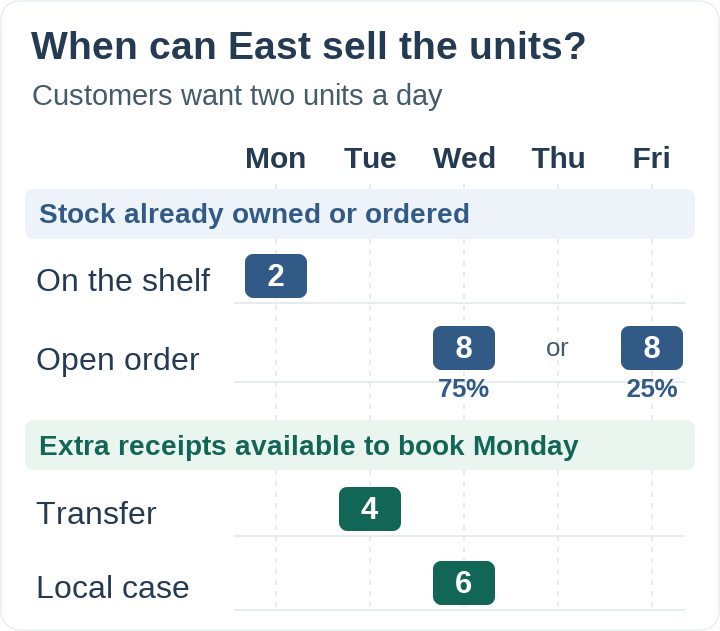
The open order brings eight units by Friday in either case. If the truck arrives on Friday, those units miss Wednesday’s and Thursday’s customers. Only the transfer can reach Tuesday’s shoppers.
Wait. Monday’s shoppers buy both units on hand. If the regular delivery arrives Wednesday, East misses Tuesday’s two sales. If it arrives Friday, East misses six sales over Tuesday, Wednesday and Thursday. The week ends with some stock on the shelf in either case.
Transfer four units. West store can send its last four as one lot for a $6 courier charge. They will be on East’s shelf on Tuesday morning. If the regular truck arrives Wednesday, the transfer saves two sales at East. If the truck is late, all four transferred units earn an extra sale there. West, however, will have nothing to offer its own customers for the rest of the week. It expects demand for either one or three units, equally likely in either delivery scenario.
Buy six units locally. A wholesaler can deliver a full case on Wednesday morning at $12 per unit plus $6 delivery. If the regular truck is on time, the local case brings no extra sales. If the truck is late, the case saves four sales on Wednesday and Thursday. The wholesaler sells six at a time, even though only four can earn an extra sale.
Follow the money across both stores
Both stores charge $30 and can return each unsold unit for $10 net on Friday. Selling a unit therefore earns $20 more than returning it. The local case costs $78 delivered. Even if none sells, the six returns bring in $60, leaving $18 to recover through extra sales. A grocer who has to discard the leftovers would face a different bill.
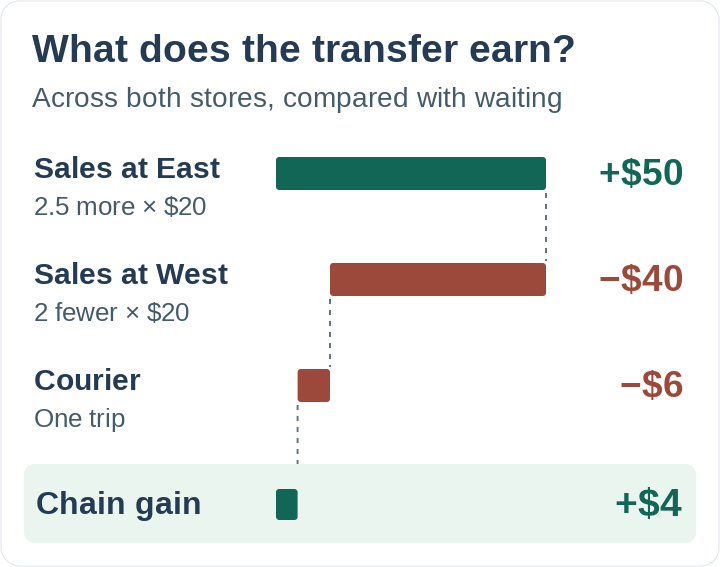
The transfer saves 2.5 sales on average at East and costs two at West. Half an extra sale across the chain is worth $10. After the courier, $4 remains.
| Extra profit across both stores, relative to waiting | Regular truck Wednesday | Regular truck Friday | Average at 25% late |
|---|---|---|---|
| Wait for the open order | $0 | $0 | $0 |
| Transfer four | −$6 | +$34 | +$4 |
| Buy the local case | −$18 | +$62 | +$2 |
| Transfer and buy | −$24 | +$56 | −$4 |
The zero for waiting is the starting point for comparison. Each arrival-day column averages over West’s possible sales. The regular order is paid for whichever choice East makes. Buying locally requires an additional $78 in cash today. The transfer needs only $6 in cash, but it commits the last four units at West.
The combination in the last row serves every customer at East. It still leaves the business $4 worse off on average than waiting. If the truck is late, both the courier and the wholesaler could cover Wednesday’s two sales. They cannot both earn credit for them. Once the local case is on order, the transfer saves only Tuesday’s two sales and gives up two at West on average. The courier bill then buys no net gain in sales.
When a late truck changes the order
At Monday’s estimate the transfer wins by $2 over the local case. If the chance of delay falls to 10%, the transfer is worth −$2 and the local case −$10. Wait, even though East will miss Tuesday’s sales. If the chance rises to 50%, the transfer earns $14 and the local case $22. Buy while the wholesaler can still guarantee Wednesday.
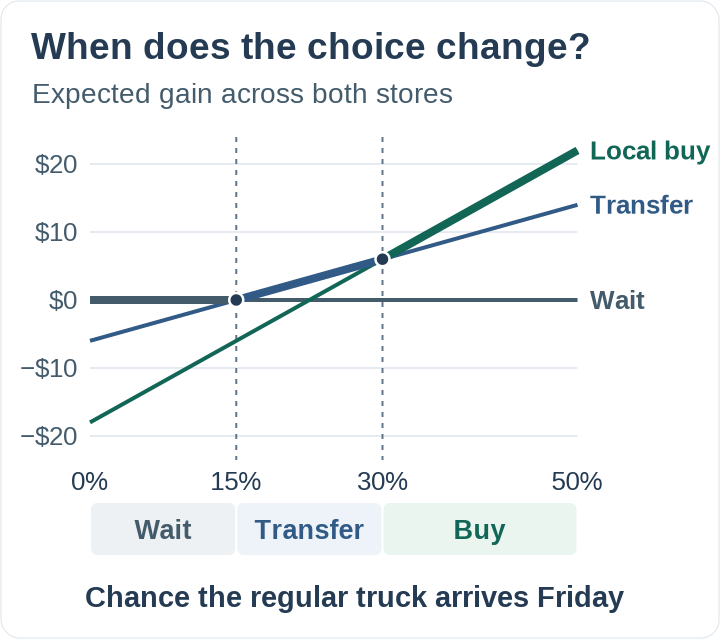
At a 15% chance of delay, the transfer just covers its cost. At 30%, buying and transferring each earn $6 more than waiting. These thresholds belong to this week’s quantities, margins and delivery offers.
How much is a call to the carrier worth? Suppose dispatch can tell the buyer for certain, before the offers expire, when the eight units will be ready for customers. The buyer would wait for a Wednesday truck and buy locally for a Friday truck. At the original one-in-four chance of delay, that earns a quarter of $62, or $15.50 on average. The buyer can already earn $4 by booking the transfer. $11.50 is the most the retailer should pay for that information on this order. A tracking update that comes after the booking deadline is worth nothing for this choice.
“Wednesday delivery” is worth checking on the wholesaler’s quote. If the case reaches the loading dock on Wednesday evening and goes on sale Thursday morning, only Thursday’s two sales can be saved before a Friday receipt. At the original 25% chance of delay, buying locally now loses $8 on average.
The buyer needs a lead-time forecast for the remaining wait. An unshipped order whose supplier has just missed dispatch has different prospects from a typical new order. If a storm delays the truck and closes both stores, the late-truck calculation must also reflect lower demand. If customers will wait for Friday, part of the benefit of an earlier receipt is a shorter delay on an existing sale. Counting the full margin again would overprice the emergency order.
The same stock position, three different decisions
East has two units on hand, eight on order and no backorders. Its inventory position is ten in all three cases above. A fixed reorder point issues the same instruction in each. Raising the threshold by adding safety stock can make the alarm sound sooner. It tells the buyer nothing about whether Tuesday’s two sales will pay for a courier, or how many shoppers the transfer will turn away at West. A planner who checks the truck’s whereabouts, calls West, and overrides the proposed order has done the economic work by hand.
The classical economic order quantity (EOQ) answers a much narrower question. Given a single item consumed at a known, constant rate, what repeating batch size minimizes ordering and holding costs? The model assumes that every unit bought will be used. At East, two of the six units from the wholesaler cannot earn an extra sale even if the truck is late. Their return value matters to the buyer. So does the prospect that all six will arrive alongside the regular order. Optimizing the frequency of repeat purchases settles neither issue.
Who gets the last space in the van?
Suppose the courier has room for just one transfer. Another store wants that slot for an unrelated item and would earn the chain $3 after freight. At Monday’s original one-in-four chance of delay, East’s transfer is worth $4. But East has a second offer. Buying locally for East earns $2 and leaves the van free to earn $3 on the other job. The two orders together earn $5, a dollar more than sending the van to East, on exactly the same demand forecast. The lecture on retail stock allocation applies the same reasoning to stock that several stores want.
Across a catalog, Lokad starts with the orders the business can actually issue. A supplier might require a whole case. Two items might share one freight charge. Price those orders on the terms available, including what the money and the goods could earn elsewhere. Friday’s return offer lets this example settle every account in one week. A seasonal purchase paid for in March can tie up cash until September. In a poor season the leftovers fetch less just when the buyer needs funds for the next collection. Both the time and the risk matter when judging the return. Prioritized ordering works through purchases across items. Chapter 8 of Introduction to Supply Chain develops the economics of waiting and committing stock.
For the original two stores, a decision-first replenishment system can issue a specific instruction on Monday morning. Send four units from West to East by courier for Tuesday opening. Once booked, those units are committed. If West dispatches only three, carry three in transit and reconcile the fourth before offering it to another store.
The replenishment decision also shapes what the buyer can learn from Tuesday. If East waits, the till will record zero sales whether two shoppers left empty-handed or nobody came in. A time series of units sold cannot distinguish those events on its own. Keep shelf availability alongside sales and record any backorders the store still owes its customers. Otherwise the buyer can cut next week’s order on the strength of this week’s zero, leave the shelf empty again, and see the forecast confirmed at the till.