
Inventory Control
A warehouse has one spare motor for two workshops. The storekeeper knows where it is, whether it runs, and whether anyone has reserved it. Keeping that account and getting the motor to the right loading dock are the work of inventory management. Someone still has to choose a destination. Should the spare go north on this morning’s van, or stay at the depot until one of the workshops calls? That choice belongs to inventory optimization.
Inventory control is the traditional name for both jobs. Taken literally, it promises the buyer too much. A buyer can order 200 motors for Friday. How many will be on the shelf that evening also depends on when the supplier delivers and who comes in for a motor. The purchase order commits the company even if the supplier is late or sales are slow.
Comparison of the two visions
| Inventory management | Inventory optimization |
|---|---|
| Features. Can a clerk receive half an order and leave the balance open? | Financial return. Which buying policy earns more on the cash tied up in spares? |
| Sets procedures. Changing how receipts are posted affects every dock. | Issues instructions. A new destination changes the shipping label. The crew loads the van as usual. |
| Always on. Picking may stop when the ledger goes down. | Due by departure. Tomorrow’s load can be calculated overnight. For a van at the gate, the dispatcher has minutes. |
| Short transactions. A scan updates a few records. | Heavier calculations. Routing one motor may draw on the breakdown history of every workshop. |
| Costly cutover. Every open order and unfinished pick must carry over. | Gradual rollout. Two policies can propose loads in parallel. Only one issues the manifest. |
What the ledger is good at
If two salesmen try to reserve the last motor a second apart, the warehouse management system (WMS) must accept one reservation and refuse the other. A third caller can then get a reliable answer over the phone. There is one motor on the shelf and none available. This working ledger is a system of records. Much of its value lies in the labor it saves. A barcode scan replaces the hand entry of a part number. In warehouses equipped by Kiva, mobile robots brought whole shelves to the pickers.1
Recording a carton in bay 17 takes a scan. Choosing what belongs in bay 17, beside the dispatch door, takes some knowledge of the business. Giving it to a fast seller can save the crew a hundred long walks a day. The same distinction applies to counting. The clerk can post a count for any bin. With a pump assembly due tomorrow, the bin of ten-cent washers that could hold up the job deserves an early count.
Suppose North shipped eight motors last week and customers returned two. South sold six on Monday and spent the rest of the week out of stock. A system of reports can give finance the correct weekly figure of six net sales apiece. The buyer needs the transactions behind those totals. They show the returns at North and how long South had an empty shelf. How many customers went elsewhere on Thursday remains an open question.2
How the reorder point got into the ledger
At an assembly bench with two bins of fasteners, the worker empties the first bin, sends it for a refill, and opens the reserve. An empty bin makes a perfectly good order when the supplier, route, and lot size are already settled. For a cheap fastener in steady use, recalculating the order every morning might cost more than it saves.
In a 1962 programming exercise, an electric motor manufacturer puts its ledger of 20,000 stock items on magnetic tape. Each part gets 54 characters. The programmer allots five digits each to the quantity on hand, the quantity on order, the reorder point, and the order size.3
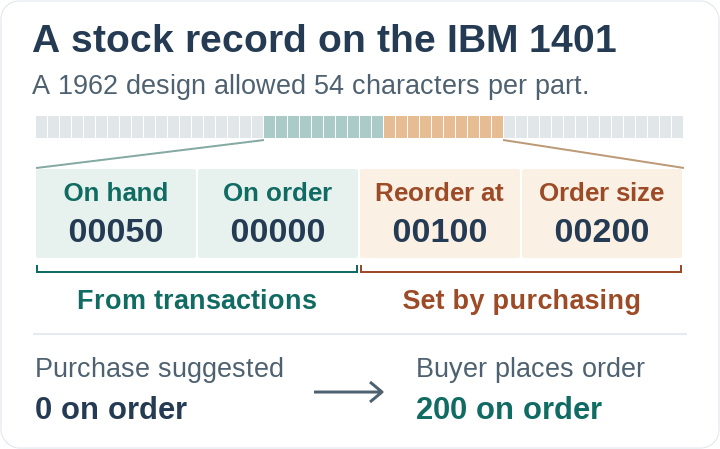
With 50 on hand and none on order, the program punches a card recommending a purchase of 200. The quantity on order stays at zero until purchasing acts. A clerk can check both stock figures against receipts, issues, and open orders. Which document would establish that the reorder point ought to be 100? That number and the lot size beside it are judgments someone in purchasing has to defend.
Vendors have been promising to automate buying since the 1970s. A buyer who used to write orders can now spend the morning adjusting service targets and correcting the orders the software suggests. With those same 50 units left, one supplier might offer a cheap lot of 200 in six weeks and another might deliver 20 tomorrow for a premium. Even a perfectly precise stock target leaves the supplier field on the order form blank.4
Sometimes the trouble lies in what gets counted. Two grocers each have 40 tubs of yogurt at closing and owe a customer 20 the next morning. At one store, 35 tubs expire tonight. The count is accurate to the tub and the grocer is 15 short for pickup. Raising the permanent target to 55 would order extra yogurt even next week, when every tub might be fresh. The buyer needs the use-by dates.
Where the last spare belongs
The depot’s spare motor has to cover one day until its replacement arrives. The morning van can drop it at either workshop for free. Once there, the motor cannot reach the other workshop in time to prevent $400 in downtime. A courier picking up at the depot can still reach either workshop after a breakdown.
For this example, only North will call on 60% of days, only South on 20%, and neither on the remaining 20%. Tomorrow the spare has the same value wherever it ends up.
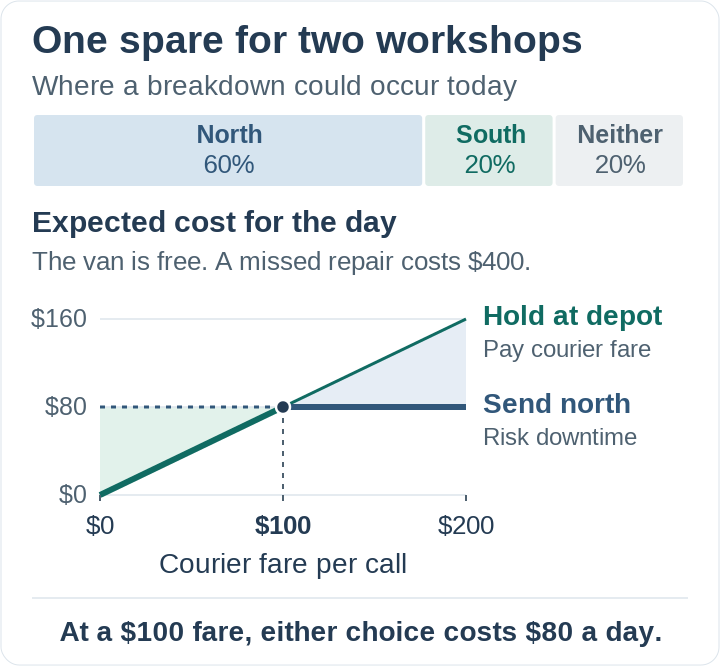
Sending the spare north leaves South exposed one day in five, at an average cost of $80 per day. Sending it south costs $240 on the same reckoning. At the depot the motor can serve either workshop, and the courier bills only when called. At $80 a trip that comes to $64 per day. A $100 fare makes the two choices equally costly. Above $100, put the motor on the morning van to North.
The depot can wait to learn where the breakdown is because the courier can still make the trip. A later pickup cutoff extends that option. With a target of one spare at each workshop, the buyer would simply order another motor. At the $80 fare, having it in place would save at most $64 today. Over its working life, the second motor has to repay its purchase price and earn a return on the cash it ties up.5
What an extra pallet space is worth
A dispatcher has four pallet spaces and 1,000 kg left on a truck already booked. Three lots are ready at the dock. Each must ship whole and can wait for the next departure. The bolts, for instance, have a 30% chance of needing a $300 emergency shipment if left behind. Sending them today is worth $90 on average. The totes and filters have their own reasons to go today, worth $100 and $80 respectively. Here, shipping one lot leaves the gain on the others unchanged.6
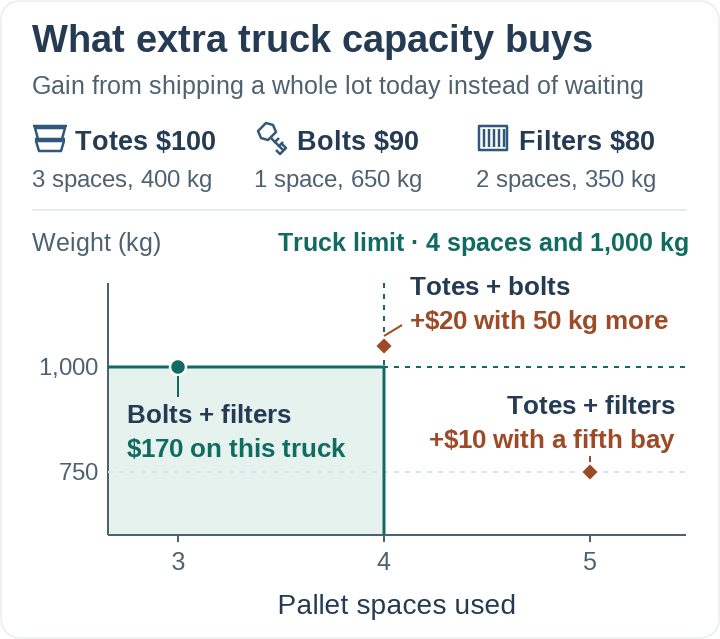
The totes are worth the most on their own. Load them first and neither remaining lot fits. The bolts and filters together earn $170 with a pallet space to spare. If the carrier offers another 50 kg of payload, the dispatcher can take the totes and bolts instead, a $20 improvement. Another pallet space would allow the totes and filters, worth just $10 more. Buying both upgrades still gains only $20. The same lot of totes figures in both offers. If the original truck had to be chartered for $180, all three lots could wait.
Rejecting an overloaded truck takes two sums and a check against the limits. Choosing which lots to leave on the dock is the expensive part of a dispatcher’s job. A system of intelligence does that work and sends the warehouse a manifest it can use. Software that flags every item below target still leaves the dispatcher to build the load.
Why the ledger and the buying logic belong apart
A minute spent comparing loads may save a freight bill. Run that calculation on the live warehouse database and a whole shift of pickers may have to wait for their scans. The dispatcher’s software can work from a copy of the transactions. When the manifest comes back, the WMS checks that the lots are still free and reserves them together. If its reply gets lost, resending the same manifest number should retrieve that reservation without printing a second pick ticket.7
Suppose a change from pieces to cases makes the morning buying run propose twelve times the usual order. Halt the run before the orders go out. Trucks are still arriving at the dock, and the crew needs the ledger to receive them while someone fixes the conversion. Clearing the alert on one order by hand leaves the error waiting for the next buyer.
When passenger traffic collapsed in 2020, some aircraft maintenance businesses put unserviceable components into storage. Before then, they would have sent the parts straight to the shop. They now had enough serviceable spares to defer the repair bill. The warehouse could keep tracking each part and its condition as before. The automatic instruction to repair every eligible component had become an expensive mistake.7
Replacing the warehouse ledger can take years. On cutover night one receipt may still be in dispute and a customer may own goods still in the building. The new ledger must honor both claims from the first scan. Those migration costs give the ERP vendor a considerable advantage when it also sells a planning module. The buyer can try a different dispatch policy far more cheaply. At Lokad, the new policy can calculate a load for every departure alongside the existing policy. Only one issues live manifests. The dispatcher can investigate disagreements for weeks, then give the new policy one depot’s departures. The pickers keep their scanners.8
Judging a decision after the fact
Say the motor went north and South lost $400 that afternoon. Was the dispatch a mistake? At a $160 courier fare, keeping the motor at the depot would have cost $128 per day on average, against $80 for sending it north. At an $80 fare, sending it north was the more expensive policy, by $16 per day on average. The $400 repair delay looks the same in either account. To judge the dispatch, the reviewer needs the fare available before the van left.
A purchase order for twenty motors can survive in the ledger for years. An offer the buyer declined may disappear with yesterday’s price list. Keeping the dated offer and the reason for passing makes it possible to investigate a shortage as well as a surplus. Over a season’s worth of orders, a buyer might find that the company routinely paid for next-day delivery on motors that sat on a shelf for a week. The buyer can then change the purchasing rule to pay the premium only when a workshop stands to lose more by waiting.4
References
-
Peter R. Wurman, Raffaello D’Andrea, and Mick Mountz, “Coordinating Hundreds of Cooperative, Autonomous Vehicles in Warehouses,” AI Magazine, 29(1), 2008. ↩︎
-
Introduction to Supply Chain, §5.2, “Classes of enterprise software.” See also Your Data Is Better Than You Think, 11:09, Perpetual Inventory and Inventory Accuracy. ↩︎
-
Daniel D. McCracken, A Guide to IBM 1401 Programming, John Wiley & Sons, 1962, chapter 10, pp. 139–145. Table 10.1 gives the field positions. The quantities in the illustration are an example. ↩︎
-
Stocks Are Not in Your Control, 10:07 on order constraints, 22:34 on perishables and 36:35 on reviewing decisions. On the history of planning software, see Introduction to Supply Chain, §6.1.2, “Muddy emergence,” and Min/Max Inventory. ↩︎ ↩︎
-
Introduction to Supply Chain, §4.3.2, “Pooling,” §8.1, “Thinking the decision,” and §8.5.3, “Postponement principle.” ↩︎
-
Optimizing Container Shipments and Introduction to Supply Chain, §12.6, “Mathematical optimization.” ↩︎
-
Introduction to Supply Chain, §6.1.4, “Conflicting design requirements.” See also Stop Planning in Your ERP, 21:52. ↩︎ ↩︎
-
Introduction to Supply Chain, §10.3.3, “Progressive rollout,” and the LokadTV discussion of deployment, 45:50. ↩︎