
Inventory Accuracy
Inventory accuracy measures how closely recorded quantities agree with a physical count of the same item, at the same location and time. Two bicycle shops have twelve folding tires between them. All twelve are at South, but someone posted the receipt to North. The head office report is right to the last tire. A customer who reserves one at North still goes home empty-handed.
The buyer has until Thursday evening to tell the supplier where to deliver the next carton. Paying a clerk to check the rack buys a chance to change that instruction. How much that chance is worth depends on what the shops can still do on Friday.
A carton on the wrong store’s books
Both shops started Thursday with none of this tire in stock. South took delivery of a carton of twelve. North got the entry. The supplier has one more carton for Friday’s truck and delivers it unopened to one shop. The buyer sends it to the shop showing zero. If nobody catches the error, North will open on Friday with none and South with twenty-four.
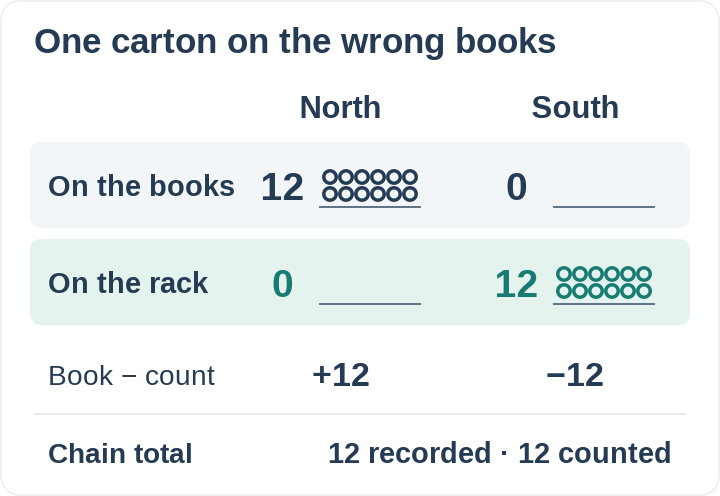
At North the twelve missing tires are phantom inventory. At South the clerk can fit a tire to a bicycle, even though the website may refuse an order for pickup. Check the delivery slip and correct the location of the receipt. Writing off twelve tires at North alone would leave the chain reporting zero for a carton it still owns.
In a perpetual inventory system, the balance starts with the last count. Each receipt, sale, and transfer moves it up or down. North can ring up every subsequent sale correctly and carry the twelve-tire error for weeks. There is a trap here for the buyer forecasting demand from sales. On a weekend when North has nothing to sell, the till records zero however many cyclists ask for a tire. Using that zero as evidence of weak demand can send the next delivery to South as well.
Three ways to score the same count
For each item at each store, subtract the number counted from the number on the books. Call the result the signed error. North is high by twelve, or +12. South is low by twelve, or −12. Averaging the two gives zero. Keep the signs when looking for a receiving process that consistently overstates stock. Take absolute values when the question is how far the records miss in either direction.
The mean absolute error (MAE) averages the size of the error across the records checked. For \(n\) records with signed errors \(e_i\), it is
\[ \mathrm{MAE}=\frac{1}{n}\sum_{i=1}^{n}|e_i|. \]
North and South contribute twelve units apiece. The sum is 24 because one misposted carton affects two records. No tires went missing in transit. The exact-match rate counts records for which the book quantity equals the count. Suppose the clerks also check 98 other item–store records, all correct and all counted in individual pieces.
| Measure | Tires only | All 100 records |
|---|---|---|
| Mean signed error | 0 | 0 |
| Mean absolute error | 12 units | 0.24 units |
| Exact matches | 0 of 2 | 98 of 100 |
The buyer can report 98% accuracy and still send Friday’s carton to the wrong shop. The percentage describes the 100 records checked. If a store accepts a two-piece tolerance, label the figure within two pieces. A one-piece error qualifies even when it leaves the shop promising its last tire to a customer.
Count against the right balance
Give the counter a part number, location, and unit of measure. Leave the expected quantity off the count sheet. Save the book balance as of the count time before anyone posts a correction. If South counts twelve tires at 9:00 and sells one at 9:05, comparing the count with the 9:10 balance of eleven creates an error where none existed. A transaction log lets the clerk reconcile movements while the shop stays open.
Keep the delivery date and the time the correction was posted. If the buyer investigates Friday’s shipment, Thursday’s screen should still be reproducible. A report rebuilt from the corrected receipt would show twelve tires at South and make it look as though the buyer had knowingly sent a second carton there.
Count what the field claims to contain. South can have twelve tires on hand, two held for a customer, and ten available to promise. All three figures are correct. If the website offers all twelve for pickup, recounting them, even with a radio-frequency identification (RFID) reader, will give the same answer. The checkout needs the available quantity. A tire with a cut in the sidewall also belongs in the physical count until it is scrapped, but nobody should be able to reserve it.
A count sheet drawn only from positive balances has another blind spot. It sends the clerk to North and omits the shelf at South that holds the carton. Check from the records to the floor and from the floor back to the records. If the same pair of stores keeps turning up, follow a receipt from the delivery slip to the screen. A receiving form that defaults to North can undo the benefit of a Friday count on the very next delivery.
Estimating accuracy from an audit
Suppose the chain has 1,000 active item–store records. An alert flags 100, and clerks check all of them. Sixty disagree with the books. The clerks also draw a simple random sample of 100 from the other 900 records and find ten more discrepancies. All figures use the balances before correction.
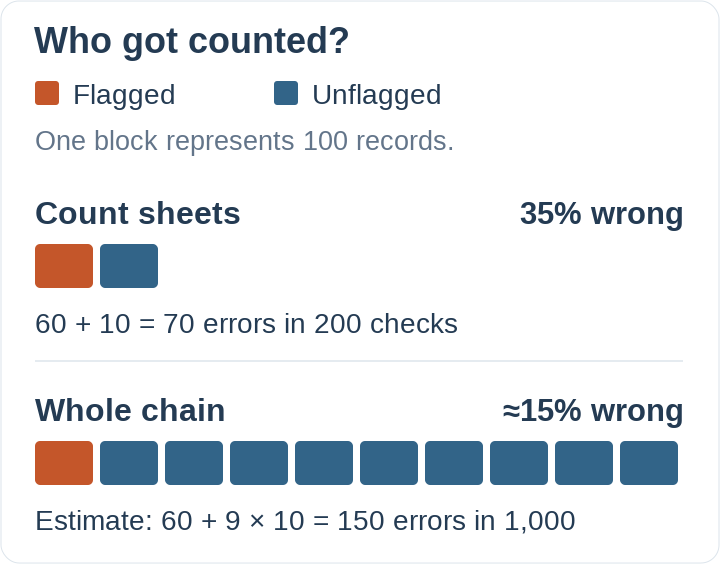
Seventy of the 200 checks found an error. 35% describes the clerk’s pile of count sheets. To estimate the chain’s error rate, keep the 60 known discrepancies among the alerts. The 10 errors in the random sample suggest about 90 in all 900 unflagged records, including the ten already found. That gives about 150 errors out of 1,000, or an estimated 85% exact matches. Another random draw could give a different answer. The alerted bins alone cannot tell the manager how often the alerts missed an error.
Give both jobs time on the count schedule. Checks prompted by gaps in sales can release an order in time to save a sale. A random sample of the other records tells the manager what those alerts overlook. Rewarding clerks for high accuracy on the bins they check would give them a reason to walk past a suspect bin.
What the retail evidence shows
Nicole DeHoratius and Ananth Raman compared nearly 370,000 inventory records with physical counts at 37 stores of one retailer. 65% of the records disagreed with the counts. The average absolute discrepancy was nearly five units, and about 15% of records missed by at least eight units. Those large-error records accounted for 28% of the inventory’s expected book value. That last figure describes the merchandise covered by those records. It does not measure how much merchandise the retailer lost.
What is the correction worth?
Find the misplaced receipt on Thursday, and the buyer can send Friday’s carton to North at the same freight cost. The next regular delivery is Monday. Suppose North stands to lose one tire sale over a quiet weekend or seven over a busy one, with the two equally likely. Each sale contributes $18 after the cost of the tire and other variable expenses. These shoppers would otherwise buy elsewhere. South has enough tires for its own customers.
Find the error on Friday, after both cartons have reached South, and there is still time to hire a courier. Moving seven tires to North before opening costs $30. The courier can cover either weekend. Leftover tires remain saleable at their usual value.
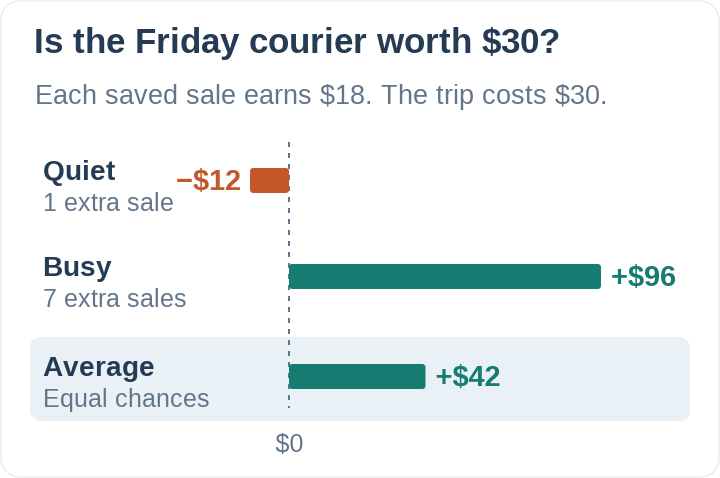
Thursday’s correction protects four sales on average, worth $72. Friday’s earns $42 on average after paying the courier. On Monday both stores could still correct their records to the last unit, but the weekend shoppers would already be gone.
Should the buyer pay for a Thursday count?
Before the count, the buyer has the carrier’s confirmation that one shop received the unopened carton. The receipt names North. Suppose past checks of comparable deliveries on this route found the wrong shop on one receipt in four. The buyer knows the chain has twelve. Averaging the two possible locations gives nine tires at North and three at South. Publishing those quantities for pickup would offer tires at a shop with an empty rack.
Both shops have the same weekend sales prospects. If the buyer must give the driver an address now, South is the better bet. It is the empty shop three times out of four. A Thursday count costs $8 and settles which shop should get the carton. Both shops will check the tires on Friday morning anyway, in time to call the courier if the truck went to the wrong shop.
When the receipt is right, the Thursday count changes nothing. When it is wrong, the count saves the $30 fare. The shops can serve the same weekend customers either way. A one-in-four chance of saving $30 is worth $7.50. Leave the tires for the regular Friday round. A fare above $32 would tip the choice the other way.
Now suppose the courier cannot make the trip. Thursday evening is the buyer’s last chance to put tires in the right shop before the weekend. Sending the truck to the wrong shop would cost $72 in expected margin. The count is now worth $18 before labor. Pay the clerk the $8 and the shops come out $10 ahead on average.
References
Nicole DeHoratius and Ananth Raman, “Inventory Record Inaccuracy: An Empirical Analysis,” Management Science 54, no. 4 (2008), 627–641.
Introduction to Supply Chain, §5.4.2, “Semantics of the data”, §8.5, “Sequential decisions”, and §9.2.5, “Instrumentation”.