
Phantom Inventory
Phantom inventory is stock that appears in a location’s records but is physically missing. A parts store can turn away a mechanic who needs an oil filter while the buyer sees four on hand and places no order.
If the display is empty, check the stockroom. A carton there belongs on the shelf. Writing it off could put a second carton on order while the first is still in the building.
How four missing filters can stop an order
The store opens on Monday with six oil filters. Two sell at noon. At four, someone throws away the crushed carton containing the last four and forgets to record the loss. The buyer orders a carton of twelve when two or fewer filters remain and no order is open. On Monday evening the screen still shows four.
On Tuesday a mechanic can ask for the filter, find the bin empty, and leave. The register has no sale to deduct. The balance stays at four, above the reorder point, however many mechanics ask. Kang and Gershwin called this inventory freezing.
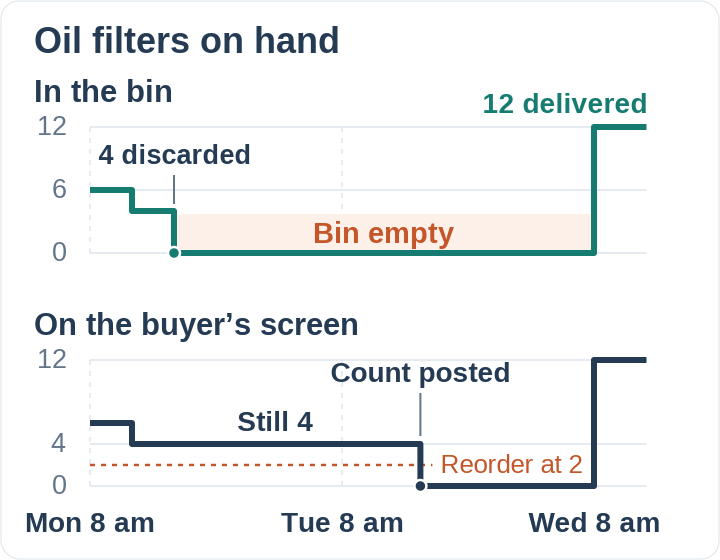
A clerk checks the stockroom and posts a count of zero at 3:28 on Tuesday afternoon. The order makes the supplier’s 3:30 cutoff. The store now has a correct balance, twelve filters on order, and nothing to hand a mechanic. The stockout lasts until the delivery at eight on Wednesday morning.
Which records deserve a second look?
A carton booked on arrival as twelve pieces when it contains ten leaves two phantom units. Theft and unrecorded damage can do the same. Scanning the wrong part number at checkout produces two errors at once. One bin appears fuller than it is and the other appears short. Both need checking. Missing goods can also leave the value of stock on the balance sheet too high.
Three days without a sale is a long time for an oil filter that usually sells several times a day. A rear wiper blade that fits one uncommon model might sit for weeks. Check whether the store was open and whether sales of a compatible filter picked up. Mechanics buying the substitute may have found the usual bin empty. Send someone to look before writing off the carton.
Lokad’s early work on targeted stock counts used past corrections to pick bins for inspection. Keep the counts that agreed with the records, too. Eight corrections in ten checks tell a different story from eight in a hundred. To find shortages the alerts overlook, set aside a few counts for bins drawn at random from the rest of the store.
In audits at dm-drogerie markt, the best rule DeHoratius and colleagues tested for finding unrecognized stockouts favored low recorded balances. It found over eight times as many as counting at random. For discrepancies of any kind, rules favoring items with high sales, high stock levels, or a history of errors did better.
One count before the cutoff
At 3:20 on Tuesday the clerk has time to check one bin. The screen still shows oil filters and rear wiper blades in stock. Suppose previous checks of comparable bins found 80% of the blade bins empty and 30% of the filter bins empty. The others held enough stock to leave the order unchanged. Checking a bin and sending any resulting order takes eight minutes. The clerk’s time costs $4 either way.
Both suppliers take orders on Tuesdays and Thursdays for delivery the next morning. Both bins will be counted on Thursday anyway. Finding an empty bin today can bring a delivery forward from Friday to Wednesday. The table includes only sales the earlier delivery would save. A customer who would wait until Friday or buy an equally profitable substitute adds no extra margin.
| If the bin is empty | Wiper blade | Oil filter |
|---|---|---|
| Extra units sold | 1 | 8 |
| Margin per unit | $8 | $6 |
| Margin recovered | $8 | $48 |
Count the oil filters. A 30% chance of recovering $48 is worth $14.40, or $10.40 after labor. For the blades, an 80% chance of recovering $8 is worth $6.40, or $2.40 after labor. A manager who rewards clerks for the number of errors they find would send this clerk to the blades. On these figures, that choice gives up $8 in expected margin.
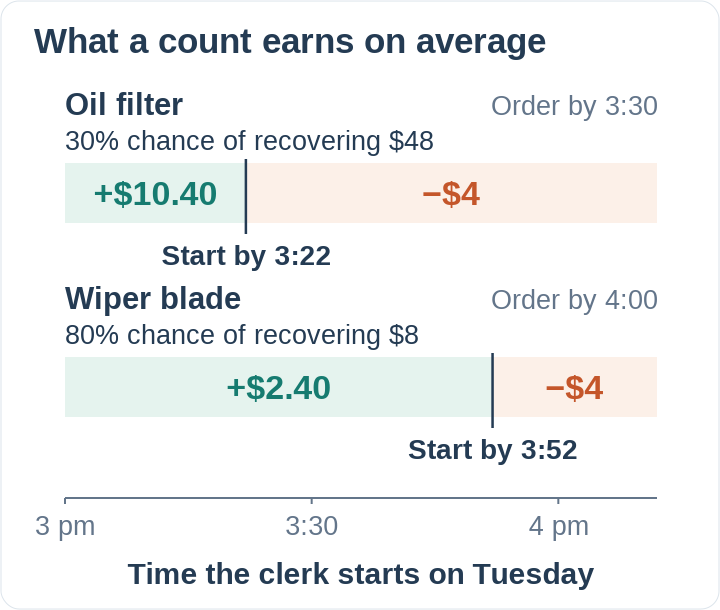
Now suppose a customer keeps the clerk at the counter until 3:23. A filter count would finish at 3:31. Even if the bin is empty, the filters would arrive on Friday, just as they would after Thursday’s regular count. Check the blades instead. Their supplier takes orders through four. After 3:52, neither check can catch a truck. Leave both bins for Thursday and save the $4.
Did the count save a sale?
Check the part number, pack size, and stock set aside for pickup before posting an adjustment. Four filters reserved for a mechanic are still on hand. If the website offers them to another customer, fix the available quantity. If a receipt was entered before the carton arrived, correct the receipt and keep the inbound order open. Canceling it could turn a bookkeeping error into a real shortage.
Record when the supplier accepted the order as well as when the clerk finished the count. If the store sends orders in an overnight batch, even a 3:28 count will miss Tuesday’s cutoff.
A chain can test whether the checks pay by choosing comparable stores at random for early counts and keeping the usual Thursday round in the others. Follow sales of filters and their substitutes past Friday’s delivery. A mechanic who buys on Wednesday instead of Friday still buys only one filter. Compare margin per store after deducting the extra labor. A check that improves inventory accuracy can still cost more than it earns.
References
Y. Kang and S. B. Gershwin, “Information inaccuracy in inventory systems: stock loss and stockout,” IIE Transactions 37 (2005), 843–859.
N. DeHoratius, A. Holzapfel, H. Kuhn, A. J. Mersereau, and M. Sternbeck, “Evaluating Count Prioritization Procedures for Improving Inventory Accuracy in Retail Stores,” Manufacturing & Service Operations Management 25 (2023), 288–306.